Get the price for the appliance installed and ready to use. Delivery, fittings, connection work and removal can erase a lower sticker price.
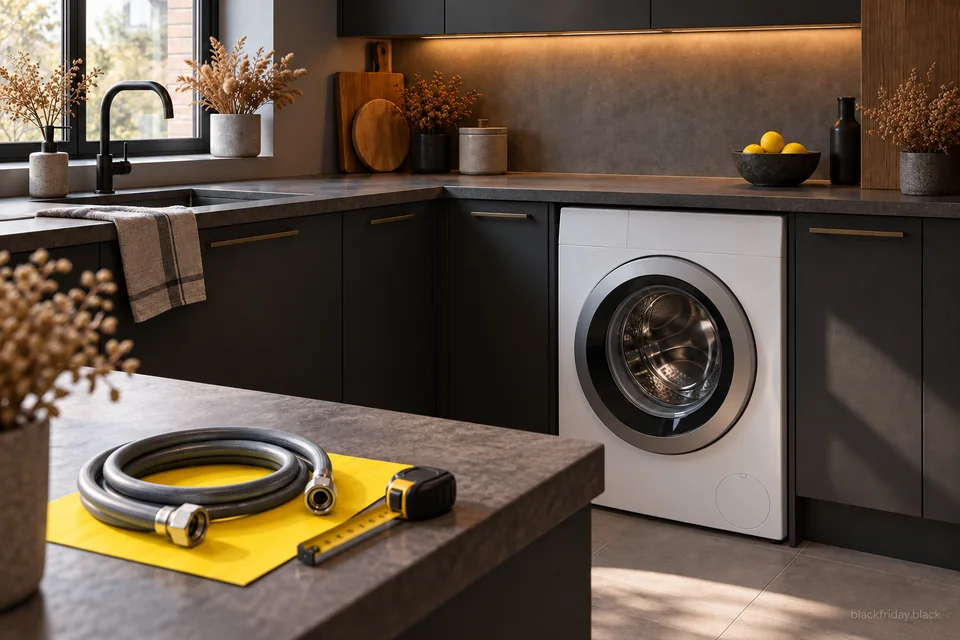
The useful price of a washing machine, dishwasher, fridge or cooker is the amount it takes to get the right appliance into your home and ready to use. That can include delivery, installation, required parts and removal of the old unit. A lower item price may leave you with the higher finished bill.
Before buying, ask for a written breakdown for your product, address and connections. “Installation available” is not the same as installation included, and “free delivery” does not tell you where the crew will leave the appliance.
This guide helps you compare offers and prepare the right questions. The actual installation must follow the model’s instructions and the relevant local requirements. A sale is not a reason to improvise gas, electrical or water connections.
Identify the replacement before choosing an offer
Write down what you have now: appliance type, model, size, built-in or freestanding arrangement, and the visible connection setup. Photograph the existing space for your own records if that helps explain it to the seller or installer.
An appliance fitting in the same nominal size category does not establish that it is a direct replacement. A built-in dishwasher may need a suitable furniture door and mounting arrangement. A cooker may need a different electrical supply. A fridge may need more clearance for ventilation or for its doors to open.
Use the candidate’s actual installation instructions. If a necessary measurement or connection requirement is missing from the sales page, ask for it. Do not treat a missing fact as a free or simple job.
If you rent, check who is responsible for the appliance and permission for changes. Avoid buying a unit that requires property work you cannot authorise. The person arranging the installation needs to know these constraints before a delivery date is booked.
Measure the route, the final space and the opening space
There are three separate fit checks. The first is the route from the vehicle to the room. Include gates, entrances, lifts, stair turns and narrow corridors. Ask whether the crew measures the packaged appliance or the unpacked unit, and what unpacking they allow along the route.
The second is the installed space. Measure width, depth and height, then apply the manufacturer’s required clearance. A recess exactly as wide as a fridge is not proof it offers suitable ventilation. Pipes, sockets and skirting can change the available depth.
The third is the space used in everyday operation. Open doors, drawers and lids in your plan. A fridge door may need to open beyond a simple right angle for drawers to come out. A dishwasher door can block a narrow kitchen while loading.
Our stair delivery guide explains how to record awkward access. Do not assume a delivery crew will remove a door, carry over a wall or dismantle the appliance. Get the actual service’s answer before ordering.
Find out exactly what delivery includes
A delivery offer may mean a kerbside drop, delivery to the entrance, or placement in the room. Stairs, long carrying routes, parking restrictions and inaccessible lifts can change the service or charge.
Ask about appointment windows and whether someone needs to be present. Confirm what happens if the crew cannot reach the room. A failed visit may leave you without the new unit and with an old one already disconnected.
Check whether delivery and installation happen during the same visit. If they are separate, find out who moves the appliance into position and how you will store it between appointments. Avoid a plan where each company assumes the other will do the difficult part.
For urgent replacement, compare confirmed delivery and installation availability. “In stock” is not a promise that every service can reach your address before the date you need.
Turn installation into a list of jobs
Ask which jobs the quoted installation covers. Does it include disconnecting the old appliance, connecting the new one, fitting supplied parts, levelling, checking for leaks and demonstrating basic operation? Does it include unpacking and packaging removal?
A retailer’s basic service often assumes suitable existing connections. Whirlpool’s US information, for example, says basic installation does not include creating new connections or altering cabinets, and availability depends on product and address. Treat that as a specific service example, then check your own seller.
| Job | What to confirm |
|---|---|
| Old appliance | Who disconnects it and prepares it for removal? |
| Water connections | Are existing fittings suitable, accessible and within the service’s scope? |
| Electrical or gas connection | Is the right qualified service included for your local requirements? |
| Built-in fitting | Are furniture panels, fixing parts and adjustments covered? |
| Setup and checks | Who levels the appliance and performs the required checks? |
| Packaging and removal | What is taken away, and must you prepare anything first? |
Keep answers attached to the quotation. A phrase such as “standard connection” is not enough if nobody has checked whether your property meets the standard assumed by that service.
Separate required parts from optional extras
Some appliances include certain hoses, brackets or fittings; others need additional parts for your installation. Check the actual contents and instructions. Do not buy a second set of included parts without a reason, but do not assume old parts should be reused either.
Ask the installer to identify required additions and quote them before the visit where possible. An unusually long run, inaccessible connection or worn fitting can put the job outside a basic package. The correct response is a defined quote, not an improvised workaround.
Accessories such as a stacking kit or furniture panel must match the appliance and arrangement. A universal-looking part may not be approved for your model. Confirm compatibility before adding it to the budget.
Keep optional purchases separate. An accessory that you like may be worth buying, but it should not hide the cost of making the appliance work safely.
Use the right qualified installer
Gas and fixed electrical work can be regulated, with requirements that differ by country and job. Check the relevant local rules and the installer’s suitable qualifications. In the UK, HSE guidance says work on gas appliances must be carried out and checked by a Gas Safe registered engineer. A registered engineer signing off someone else’s unauthorised work is not a substitute.
For other markets and connection types, use the appropriate local professional and the appliance’s instructions. A familiar plug shape or matching pipe does not prove that the location is suitable.
If the seller’s package does not cover the required work, arrange a separate qualified service and include its quote. Do not let the promise of a small saving turn an unresolved installation into a risky do-it-yourself job.
Compare two complete offers
Here is a hypothetical comparison in pounds. It is a calculation example, not a current retailer price list.
| Cost | Machine A | Machine B |
|---|---|---|
| Appliance | £400 | £470 |
| Delivery | £30 | Included |
| Installation | £70 | Included |
| Required parts | £20 | £20 |
| Old-unit removal | £25 | Included |
| Complete purchase | £545 | £490 |
Machine B costs £70 more on the product page but £55 less as the finished purchase. This works only if the included services cover the same jobs. If B excludes disconnection and you need a separate £80 visit, the answer changes.
Mark unquoted work as unresolved. Putting £0 in the table makes the offer appear cheaper without evidence. Keep taxes and mandatory charges consistent, and do not count delivery or parts twice when they are already in a package.
Our discount guide explains why a large reduction from a reference price does not settle this comparison.
Removal can be its own service
Ask whether the old unit must be emptied, disconnected, defrosted or placed somewhere accessible. Check whether the crew removes only a like-for-like appliance and whether stairs or a second unit carry an extra charge.
If you arrange removal elsewhere, plan the timing. You may need the old appliance until the replacement is installed, especially if a delivery could fail. A large disconnected unit can also block the space needed for the new installation.
Use an appropriate local disposal or collection route. Ask what service you are buying rather than assuming the retailer’s removal includes every handling or environmental step. Keep any useful collection receipt with your purchase records.
Add running costs using clear assumptions
The installed price is one part of ownership. Energy and water use can matter over years, but compare similar size and function. A larger appliance may offer more capacity while consuming more overall.
In the US, EnergyGuide labels provide estimated use and cost under stated assumptions. The label’s cost is not a prediction of your own bill. In other markets, use the energy information supplied for that market and read what each figure measures.
For a simple hypothetical estimate, annual electricity use of 200 kWh at your assumed £0.25 per kWh gives £50 a year. At £0.35, it gives £70. The change comes from the tariff, not the appliance. Use an appropriate annual-use figure and label your tariff assumption.
Compare running-cost differences with the purchase premium. If two suitable models differ by an estimated £10 a year and one costs £120 more installed, energy alone would take about twelve years to cover the difference under those assumptions. That calculation is not a guaranteed payback: your use, tariffs and repair needs may change.
Plan the day and check the completed job
Clear the agreed route, arrange access and follow the delivery service’s preparation instructions. Keep children, pets and loose objects away from the work area. Do not disconnect a working appliance early unless the installation plan requires it.
At arrival, check the model and visible condition using the seller’s process. After installation, ask about the required checks and basic controls. Washing machines, for example, have transport and levelling requirements set out in their own manuals; these should be part of a correct installation, not details left for you to guess.
Keep the invoice, service scope and any relevant installation record. Report a problem accurately and promptly through the appropriate route. The returns guide explains why faulty-goods rights and a voluntary change-of-mind policy are different.
A good appliance deal fits the home, reaches it on workable terms and has a clear price for becoming usable. Get those answers first. The sale price can then be compared without surprises waiting behind it.
A robot vacuum has a different kind of installation requirement: a usable dock location and a cleaning route it can negotiate. Our robot vacuum home-fit guide explains the space, obstacles and upkeep to check before counting its purchase price as the finished cost.