Match the tool, battery and charger by exact platform and manufacturer guidance, then buy enough capacity for the task without paying for tools you do not need.
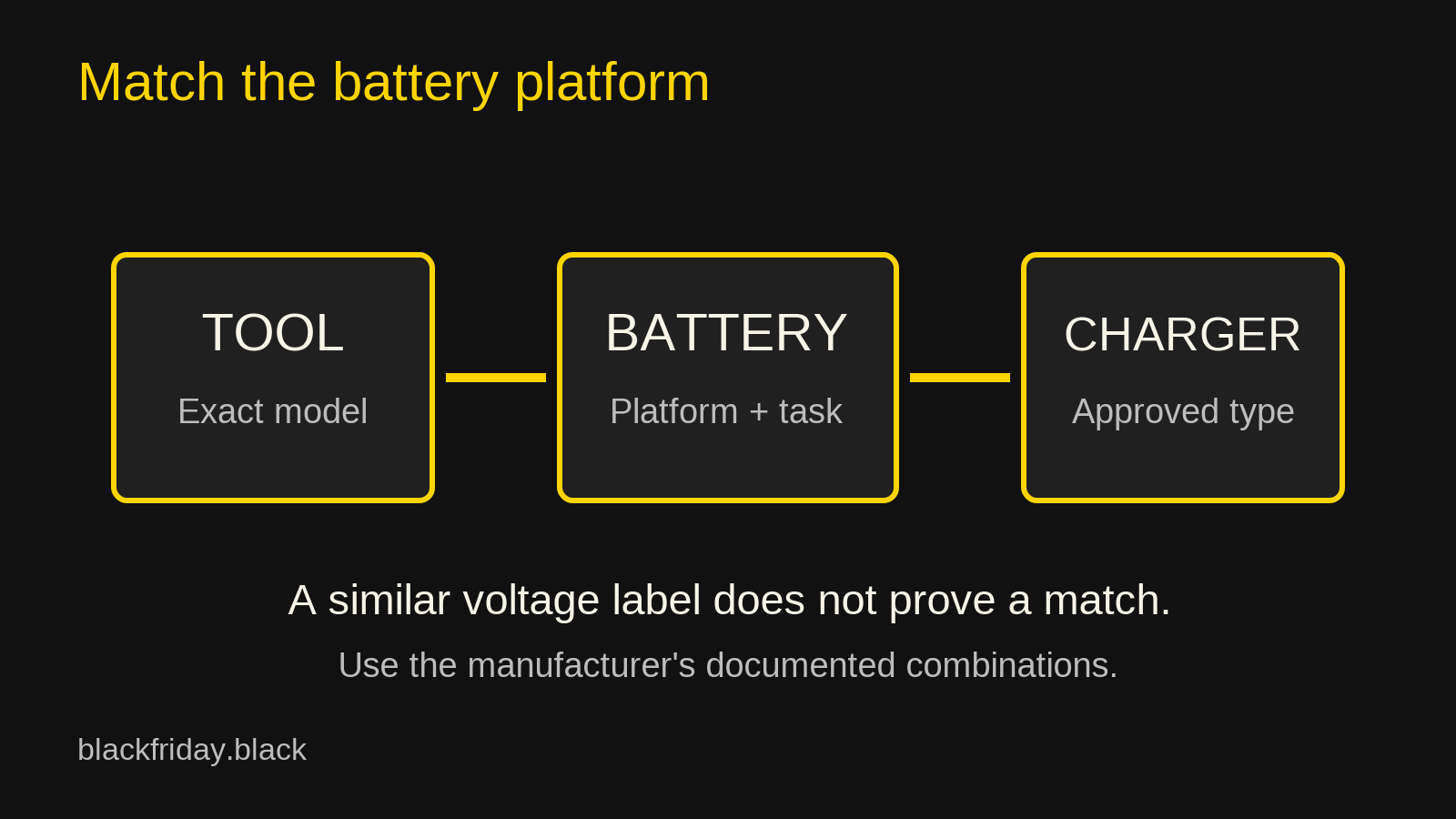
A cordless-tool battery is a good match when the manufacturer supports that exact battery on that exact tool, the charger supports the pack, and the combination suits your job. Voltage alone is not a compatibility test. A familiar brand colour is not one either.
Before comparing a Black Friday kit, photograph the labels on your existing tools, batteries and charger. Record their model codes and platform names. Then identify the actual tool and pack supplied in the offer. This short exercise can prevent an inexpensive bare tool from turning into a second, unnecessarily costly battery system.
Compatibility also has two layers: a battery can be supported by the platform while a different supported pack is recommended for the tool’s intended performance. The buying decision needs both answers. This guide concerns documentary checks and ownership costs; it does not report physical testing of tools or batteries.
Start with the work, not the number of tools
Describe the next jobs you expect to do. Assembling occasional furniture, drilling masonry, cutting sheet material and maintaining a garden are different demands. Choose the tool type and appropriate accessories before deciding that a large kit is good value.
A drill and an impact driver are not interchangeable just because both can turn something. Similarly, battery compatibility does not make a drill suitable for every material or bit size. Read the intended tool’s rated applications, capacity and operating instructions. The cheapest tool that cannot perform the job is an extra purchase waiting to happen.
If you only need one demanding tool for a short project, compare rental or a suitable corded alternative where practical. Include access, extension arrangements approved for the equipment and the convenience you would lose. Owning a battery platform is valuable when you expect to reuse it; it is less compelling when the tool will spend years in storage.
Build a three-part compatibility record
Use the manufacturer’s current product page or manual, keeping the region and model suffix correct. Record the tool, each supplied battery and the charger separately. Retail descriptions sometimes shorten these details or show a photograph containing optional accessories.
| Component | What you need to identify |
|---|---|
| Tool | Full model, platform, required pack type and any performance recommendation |
| Battery | Full model, platform, stated capacity and supported tools |
| Charger | Full model, supported packs, mains input and charging information |
| Existing equipment | Whether the new components work with your actual models |
A kit suffix can change the battery count, capacity, charger or case while leaving the tool body unchanged. Compare the written “includes” list with the selected variant at checkout. If you cannot identify the supplied battery, you cannot properly value the kit.
Ask support for the exact combination if there is a conflict between a listing and a manual. Keep the response. Do not force a pack onto a tool, remove a locating tab or treat an aftermarket adapter’s sales claim as manufacturer approval.
Understand what voltage labels tell you
Voltage describes one aspect of an electrical system. Manufacturers and markets can use different labelling conventions, so a larger printed number does not by itself establish a better tool or a compatible pack.
DEWALT’s US FLEXVOLT material, for example, distinguishes maximum initial voltage from nominal voltage: its 20V MAX label corresponds to 18 volts nominal, while 60V MAX corresponds to 54 volts nominal. That does not mean any 18-volt battery from any brand fits a 20V MAX tool. The platform, electronics and manufacturer approval still matter.
DEWALT’s UK support gives an especially useful directional example. It says an ordinary 18V battery cannot run an XR FLEXVOLT tool requiring a 54V supply, while a FLEXVOLT battery can operate most 18V XR tools. Compatibility in one direction does not prove compatibility in reverse. Check exceptions and the exact model rather than extending that statement to every product carrying related branding.
Other platforms have their own arrangements. Milwaukee states that M18 batteries are compatible with its M18 tools and chargers. That statement is about the M18 system; it does not merge M18 with M12 or another manufacturer’s system. Its battery selection guidance also distinguishes battery performance characteristics within a supported platform.
Capacity affects the workday, weight and budget
Amp-hours, usually written Ah, describe electrical charge capacity. They are useful when comparing supported batteries at the same nominal voltage, but they are not a promise of working minutes. Actual runtime depends on the tool, task, load and operating conditions.
For a hypothetical comparison within one approved platform, a 2Ah pack may be attractive for brief overhead fastening because the complete tool is easier to handle. A larger pack may suit longer work where stopping is inconvenient. Check the actual weight and manufacturer’s recommendations instead of assuming maximum capacity is always the best choice.
Watt-hours provide an energy comparison when voltage differs: nominal volts multiplied by amp-hours gives approximate watt-hours. A hypothetical 18V, 5Ah pack is about 90Wh. That arithmetic does not establish tool compatibility, available power, safety approval or equal runtime across unrelated tools. It simply prevents comparing Ah labels as if voltage did not exist.
High-demand tools may have manufacturer-recommended battery types for their intended performance. Find that recommendation before assuming the smallest included pack represents the capability shown in a promotional demonstration. A kit can be compatible yet poorly matched to your planned cutting, grinding or other sustained work.
Read the charger as carefully as the tool
Identify which battery families the charger accepts and whether it can charge multiple packs simultaneously or only one after another. A two-slot appearance does not settle how charging is managed. Read the exact model’s instructions.
Look at the published charging time for the supplied pack rather than quoting the fastest time for another battery. Consider the actual sequence of your work. One pack can work well for occasional tasks. Two can be helpful for longer sessions, provided the charging arrangement and task demand make rotation practical.
A fast charger has less value if the job is finished before the first pack empties. Conversely, the lowest-cost kit may need another battery immediately if you cannot tolerate a long pause. Price that addition before comparing the banners.
For imported equipment, check charger mains input, plug and local support. A travel plug adapter changes the physical connection; it does not establish that an electrical device supports the local supply. Follow the charger’s instructions and local requirements. Avoid buying an import on the assumption that you will solve the electrical details afterward.
Compare bare tools and kits with usable totals
A bare tool normally means the tool body without some or all power-system components, but the listing’s exact contents control your purchase. It can be excellent value when you already own suitable batteries and a charger. It can be a misleadingly low starting price for a first-time buyer.
Consider a hypothetical example in one currency. A bare tool costs 90, the appropriate battery costs 65 and the charger costs 35. Your starting total is 190. A 170 kit containing the same tool, suitable battery and charger would cost less to get working. These figures are invented to explain the comparison and describe no current offer.
Now change the buyer: someone who already owns an approved battery and charger may only need the 90 tool. Assigning full retail value to duplicated components can make the 170 kit look better than it is. Check whether a spare pack would solve a real problem before valuing it at the price of a new one.
Include task-specific bits, blades, extraction connections, suitable protective equipment and storage where needed. A bundle’s large accessory count can obscure how few items fit your materials and tool. The bundle value method helps compare useful contents, while the checkout total guide captures shipping and other actual charges.
Choose a platform without buying an imaginary future
Look one or two purchases ahead. Does the platform offer the next tool you are likely to need at a level you can afford? Are genuine replacement packs and service available locally? Those questions are more useful than choosing the catalogue with the largest headline tool count.
However, do not buy several unnecessary tools to avoid a hypothetical switch later. Owning one battery does not oblige you to make every future purchase within that system. A second platform can make sense when it solves a specific job well enough to justify its additional charger and batteries.
For used or refurbished equipment, establish the condition and provenance of both the tool and pack. Cosmetic wear does not reveal battery history. Ask what has been checked, what is included and how the seller handles faults. The refurbished comparison explains how condition and missing accessories change the value calculation.
Inspect the delivered combination before the project starts
Compare the delivered model codes with the invoice and saved listing. Inspect for damage and follow the manual’s charging, storage and operating instructions. Stop using damaged equipment and contact the relevant supplier or manufacturer rather than attempting a battery repair.
Check the release latch and secure fit with the tool in the state required by its manual. Fit the correct accessory, use the prescribed guards and establish a safe work area. Perform a suitable initial check following the instructions before relying on the tool for a time-sensitive project. This is a plan for your verification, not a claim that we have tested any particular kit.
Buy the bare tool when your existing supported power system genuinely covers the job. Buy a kit when its specified packs and charger make the usable total better. Walk away from a comparison built around unknown battery models, unsupported adaptations or tools you cannot name a use for. A clear platform record is more valuable than a larger discount badge.